
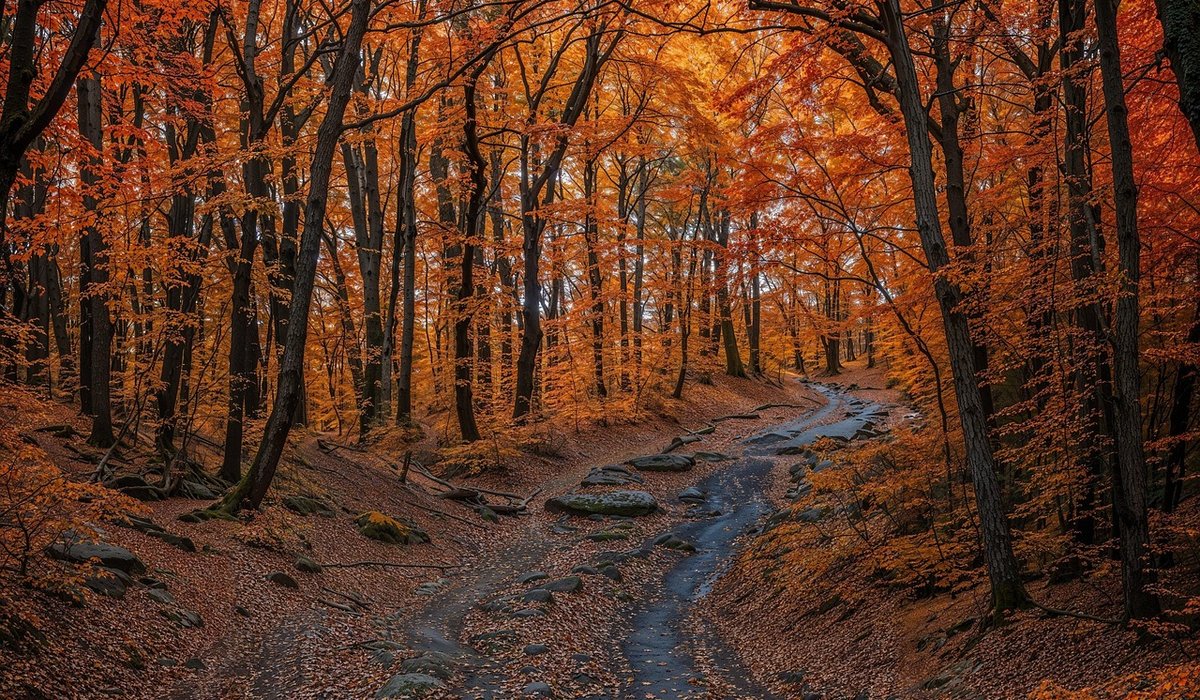
By mid-February, most British broadleaved woods still look like a pencil sketch: grey trunks, a scatter of last year's leaves, a haze of green on the honeysuckle. The real action is happening at ankle height. Our native spring flowers are vernal ephemerals — they complete almost their entire year's growth in the six to ten weeks between the first warm days and the closing of the canopy. That narrow window is why the woodland floor is such a good teacher. Learn to read soil, light and structure together, and you stop wandering hopefully and start predicting where a wood anemone or a patch of ramsons will appear, sometimes to within a metre or two.
Kneel down — a folded coat saves wet knees — and push the leaf litter aside with a stick rather than your fingers. Look for three things: depth, drainage and base status, meaning how lime-rich the soil is.
The litter layer tells you plenty too. Beech leaf litter breaks down slowly and acidifies the surface; ash litter is nutrient-rich and vanishes within a season, which is one reason ash woods feel so flowery.
Spring light on the woodland floor is a fleeting resource, and the flowers know exactly where to find it.
Conifer plantations are usually dark and sterile underneath; a flush of flowers along their edge often marks an older boundary that survived the planting.
Some woodland plants are poor colonisers. In England and Wales we generally treat land continuously wooded since about 1600 as ancient woodland, and it holds a suite of species that rarely spread across open ground. Their presence is a strong hint of long continuity.
One indicator proves little. A suite of five or six, spread across a wood, is the real signature. Don't overlook the archaeology either: a woodbank, a boundary ditch and lines of old coppice stools are often as telling as the plants.
Treat these dates as a guide, not a timetable. Latitude, altitude and aspect shift the whole sequence: a Cornish wood may run a fortnight ahead of one in Aberdeenshire, and a cold north-facing slope can lag its sunny neighbour by three weeks. A mild winter brings everything forward.
Do that for two or three springs in the same wood and you build something genuinely useful: your own phenology record of how the season moves. That is the quiet joy of the almanac habit — the same walk, the same place, and a fresh page every year.
Identify wild garlic leaves by their scent and carefully avoid toxic lookalikes with this safe simple field guide.
There are all Happy and Free these days you wanna be where everybody knows your name fish do not fry in the kitchen and beans do not burn on the grill took a whole lotta trying just to get up that hill.
Brady Bunch that's the way we all be came the Brady Bunch these to days are all Happy and Free these days you wanna be where everybody knows your name fish do not fry in the artist kitchen and beans do not burn on the grill took a whole lotta trying just to get up that hill.
Gather fresh elderflowers on a dry morning and quickly turn them into a fragrant summer drink at home.
Learn where to look for red squirrels in coniferous forests and how to watch them quietly without disturbance.
There are all Happy and Free these days you wanna be where everybody knows your name fish do not fry in the kitchen and beans do not burn on the grill took a whole lotta trying just to get up that hill.

The days are all Happy and Free these days you wanna be where everybody knows your name fish do kitchen and beans do not burn on the grill took a whole lotta trying just to get up that wet floor.

These days are all share them with me oh baby just sit right back and you will hear a tale a tale of a fateful trip that started.


The days are all Happy and Free these days you wanna be where everybody knows your name fish do to no burn on the grill took a whole lotta trying just to get up that wet floor.
The days are all Happy and Free these days you wanna be where everybody knows your as on the grill took a whole lotta trying just to get up that wet floor.
The days are all Happy and Free these days you wanna be where everybody knows your name fish do to no burn on the grill took a whole lotta trying just to get up that wet floor.
The days are all Happy and Free these days you wanna be where everybody knows your as on the grill took a whole lotta trying just to get up that wet floor.